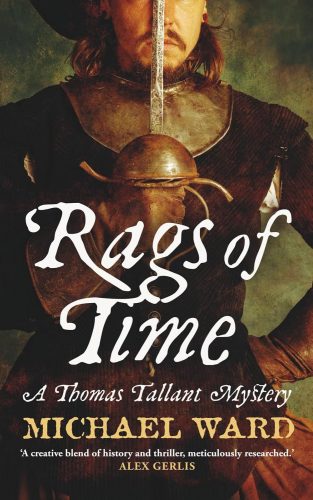
‘Sir Joseph Venell considered his sin, and smiled.’
Unfortunately for Sir Joseph, his smile is swiftly replaced by a grimace of fear as he is brutally attacked by an invisible adversary and left for dead in his own field.
What has happened to Sir Joseph? Why do the investigators believe Thomas Tallant, a spice merchant newly returned from India, is involved? When Sir Joseph’s business partner dies in an accident while drinking and dining on his parents’ property, the investigators become convinced that Thomas must be responsible. Can his new friend, gambler and logician Elizabeth Seymour, help him escape the noose?
What’s it about?
Life in London in 1639/40 as civil war approaches and the mystery of who is conspiring against Thomas – and who he can trust.
The politics of the era are, inevitably, a crucial element of the plot, but Tallant’s focus is the impact of politics on his business – and the shadow of arrest hanging over him.
Solving the mystery of the deaths is put on hold while a more pressing issue develops involving seditious pamphlets and a printing press, with Thomas consistently his worst enemy – which leads him to make several new enemies!
What’s it like?
‘Rags of Time’ gives an interesting insight into some of the issues of the period and is a slow burn mystery with a largely satisfactory resolution (other than the perennial issue in any tale of this kind, where there is at least one moment when the ultimate villain should shoot to kill and, bizarrely, doesn’t, leaving the hero to fight again another day).
I was a little bit frustrated at times by the way Ward uses Thomas’ father to deliver chunks of historical background; this felt false to me. Similarly, I was a bit shaken out of the narrative by a few abrupt slips into the first person, present tense. These few lurches could easily have been softened by placing them in italics to isolate them as Thomas’ thoughts; leaving them undifferentiated from the third person narration made those moments jarring to me.
I quite liked the final resolution as it explains a few aspects that didn’t make sense and, I think, perfectly captures a certain class of individual’s sense of entitlement. I was also relieved that the novel didn’t stray into the supernatural, as the opening chapter did seem to open up the potential for this kind of story, until the practical investigator explained his theory about what had happened.
Final thoughts
This was an enjoyable read which gave me a different perspective on the build up to the English Civil War than Robert Harris’ ‘Act of Oblivion’, which I also read recently. This is the start of a series featuring Thomas Tallant and the ending begins to set up ideas that I assume will be relevant to the second book, ‘The Wrecking Storm’. Hopefully the second book features more Elizabeth Seymour, whose brains could surely keep Thomas from getting into quite as much trouble as he does here!