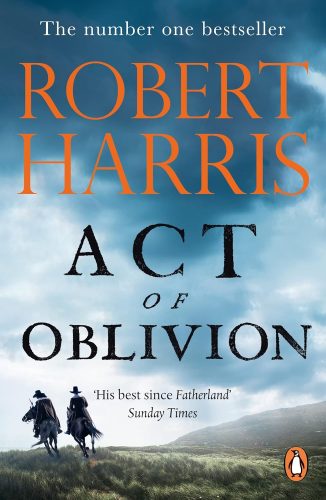
Two men flee across a continent, wanted dead or alive. Their crime? They killed the King…
History records that Puritans Edward Whalley and his son-in-law, William Goffe, fled to America to escape the Act of Oblivion, passed in 1660, pardoning all Civil War participants except the 59 who had signed the death warrant for King Charles I. Harris has imagined what happened to them during their flight – and created a most determined hunter, Richard Nayler, who will hunt them for the rest of their lives.
What’s it about?
One man’s crusade to capture two men, against whom he has a personal vendetta; those same two men’s lifelong efforts to escape their hunter, all the while feeling his breath on the back of their necks. Meanwhile, the reader is treated to vignettes from the preceding years of the English Republic, as Ned Whalley reflects on his years spent serving his his cousin, Oliver Cromwell, and insights into the colonisation of America.
Harris is keen to show us that both Royalists and Parliamentarians were brutal in their determination to pursue their vision, deliberately reflecting one devastating maternity scene in another potentially devastating one, years later, and treating the reader to detailed descriptions of an exhumation and several incidences of hanging, drawing and quartering. The descriptions are factual rather than deliberately gory, but the dangers inherent in this supposedly ‘civilised’ society are vividly illustrated.
What’s it like?
Consistently interesting, due to the historical details incorporated, but unevenly paced. After the excitement of the opening chapters, the novel risks settling into a monotony: as the enemy advances, the regicides are repeatedly forced to narrow their lives towards mere subsistence, increasingly isolated from society and sustained by the thought that, one day, the political direction will shift in their favour and they can step back into society. After all, even if the Puritans cannot fathom its shape, they know that God has a plan.
The final quarter of the book is perhaps particularly quiet in action; as the years grind inexorably onwards, Harris treats us to classic episodes from the historical period, as, back in London, Frances (Ned’s daughter, Will’s wife) must protect her family from first the Black Death and then the Great Fire of London. These scenes are interesting but lacking in urgency until, finally, Harris relights the narrative fire and rustles up a suitably dramatic ending for all involved.
What’s to like?
Although none of the characters are ‘likeable’ (the major players are all far too obsessively minded for that!) they are well rounded and convincing, especially in one particular scene, where Will suddenly seems to think he is sufficiently akin to Jesus to emulate his actions in the Bible. He quickly finds out that this is not the case, in a harsh reminder of the circumscription of their exiled lives.
As a modern reader, I really wanted the characters to display greater agency and found their passive acceptance of their situation frustrating. If you want political change, I longed to shout at them, then stop hiding and go forth to effect it! However, their absolute adherence to their faith and blind trust in God’s plan was evident and historically appropriate, even if it times it risked creating quite a dull story!
Final thoughts
I enjoyed reading ‘Act of Oblivion’ because I am interested in this historical period, but this is definitely not the thriller that the blurb hints at. Whalley and Goffe hide; Nayler seeks; and meanwhile the political world pursues whatever is expedient. Where this does become fascinating is in its depiction of the power of religious mania to cover despotism and religious intolerance to pull apart communities.



1 Comment
Enjoyed the exciting story. It only let me down at the very end. The closing pistol shot would have been a challenge for even George S. Patton, Jr., with modern weapon and ammo. No way an inexperienced shooter could have made that shot. Pistols are difficult to shoot accurately, much more than rifles.