Reproductive rights are frequently a source of controversy.
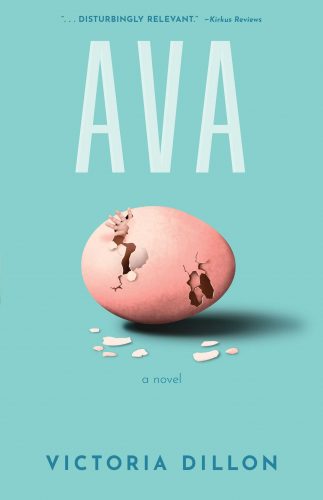
In ‘Ava’, Victoria Dillon imagines a world in which, post Roe vs Wade, and in an increasingly authoritarian America, women’s ability to make choices about their own bodies are restricted to the point where one scientist decides the only way to freedom is to change the very nature of birth itself…
What’s it about?
After Larkin suffers a devastating pregnancy, forced to carry to term a baby who will inevitably die hours or days after the birth, she is offered the opportunity to be part of a complete re-writing of biology: replacing gestation with incubation.
Years later her resulting child, astonished by the decision made on her behalf, will challenge Larkin’s beliefs. What does bodily autonomy really mean?
What’s it like?
The science behind ‘Ava’ is interesting but it’s embedded in a narrative that feels too didactic. 223 pages aim to encompass a great deal – twenty plus years of Larkin’s life and many political changes, plus the entire span of James Davis Junior’s life – and this is achieved by ensuring every interaction in the novel is short and to-the-point, selected to illustrate the potentially negative outcomes of the political decisions. Larkin’s best friend, Aubrey, exists only insofar as she illustrates Dillon’s concerns; ditto Spencer’s Republican boss. Frequently, Dillon opts to assert rather than show.
In fact, all of the characters visibly exist to serve the overarching theme of the novel: reproductive rights are good; any restriction of these rights is bad; anyone who agrees with the political direction of travel just hasn’t thought it through (Spencer’s parents perform a remarkable U-turn in the last chapter of the story, because, of course, their beliefs were founded on nothing more solid than prejudice and herd mentality).
In this story, no ‘traditional’ pregnancy is simple, no ‘traditional’ birth is straightforward and, in this increasingly dictatorial world, Larkin’s decision makes sense – though it was Ava’s objections that I found most interesting. Life is not this simple and it would have been interesting to wrestle more with the complexities inherent in all the issues raised. In particular, the fact that the entire issue is the removal of women’s choice, but the solution in this story involves removing from birth the choice to have a ‘traditional’ biology and experience of pregnancy, birth and lactation.
Final thoughts
This was a genuinely interesting read and I am aware that the elements which frustrated me may be exactly those which please other readers: the focus on the narrative messaging means there is no extraneous information, action or dialogue, and the simplistic moral sentiments expressed present a clear – albeit thoroughly one sided! – argument.
Ava is the most interesting character and the third section of the novel engages more with real world consequences of Larkin’s choice, though still in a very surface manner. I would have liked richer world building, more complex conversations and characterisations, and a more subtle message but ultimately this is a novel whose narration is as urgent as its message: look at where American reproductive rights are heading; what can and what should be done?