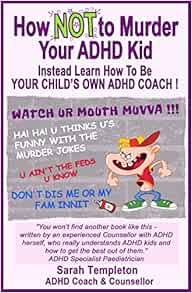
So your child has received an ADHD diagnosis. What now?
Now, you learn how to help your child manage the way their brain works, and ADHD coach and therapist Sarah Templeton is here to help you. Diagnosed with ADHD herself in adulthood, Sarah is very familiar with the consequences of unmanaged ADHD wants you to know just what NOT to do and – crucially – what “works better”.
What’s it about?
See above. Having spent years working with and empathising with young teenage offenders, many of whom had been diagnosed with ADHD, Sarah’s discovery of her own neurodiversity led her to want to support families before their children become offenders. In her introduction Sarah stresses that: ‘I’m in your corner and together we will give your ADHD child the absolute best chance there is’.
After explaining the basics of ADHD – the three core types, the key traits and general advice about management systems – Sarah helpfully organises chapters according to a list of familiar – and hopefully less familiar! – concerns, ranging from the classic, ‘When they won’t do as they’re told’, to the rather more concerning, ‘When they start stealing from you and others’. (When?!?)
Organising chapters like this makes it easy to use this as a reference guide, though if you do read through in a linear way, an overarching theme quickly emerges: how to successfully steer your child away from maladaptive approaches and how to pragmatically support them to succeed. At some point, she suggests in the chapter on hygiene, they will realise that they stink, and will take steps to remedy the problem. Meanwhile, be patient, drop hints or explore the possibility of a reward.
What’s it like?
The audiobook is narrated by the author herself, which I enjoyed; Sarah’s brusque, no-nonsense tone complements her strident advice, which often begins with ‘Don’t’ or ‘Don’t even think about’. Having worked with multiple children and teenagers whose ADHD has put them in a fix, Sarah’s advice is self-evidently valuable, though it may often seem more achievable in theory than in the heat of the moment.
In essence, parents: you must be calm and unflappable, even when confronted with a child taking drugs or getting arrested. This feels like it might be easier to achieve if you are neurotypical yourself, though Sarah herself warns early on that this isn’t likely. Indeed, one of her very first pieces of advice is to look around you for family members who may share your child’s diagnosis. The apple, she insists, rarely falls far from the tree.
Given this knowledge, it is perhaps a little harder to imagine the impulsive ADHD adult successfully mentoring the impulsive ADHD child, but, equally, her basic premise is inarguable: it is almost always going to be more effective in the long term to consider WHY a child is (e.g.) taking drugs and to attempt to discuss how else they could achieve their aims, than it would be to sob at and threaten that child because you have found out that something worrying is happening.
What is missing?
One key omission that I found slightly surprising was the limited discussion of known co-morbidities. OCD and BPD do get mentions, but I don’t recall any sustained discussion of autism. Yes, I know, I know, I read the title, too, but based on my own knowledge of common co-morbidities, I’m sure some of those incarcerated ADHDers were also autistic, which could easily complicate Sarah’s slightly simplistic suggestions. What if my ADHDer isn’t showering, not because they’re they’re bored of hygiene, but because they have sensory sensitivities or they have developed a water related anxiety?
Then again, see the title: this is for parents of the ADHDers, and a curiosity about ‘why’ and an openness to creating routines that work, rather than relying on ‘because I told you so!’ will be relevant to all parents.
Final thoughts
Sarah’s suggestions lean heavily on bribery (framed as ‘reward systems’) but there are a lot of practical gems in there, too, including suggested further reading and a very useful sounding CBT website. Ultimately, as she would doubtless tell you herself, ADHDers believe they are always right; if you agree with her core tenets then you’ll likely appreciate this book.
This is a very anecdotal book, based on the thousands of children / teenagers Sarah has worked with, so expect insights based on her experience of when things go wrong, rather than academic references and studies (as the rather tongue in cheek title has no doubt suggested!)
Her core philosophy, stated early on, is that your child needs to know that you are on their side and you need to understand how their brain works, both of which seem eminently reasonable propositions. Now, if you’ll excuse me, I’m off to listen again to, ‘When they won’t come off the X-box, PlayStation etc.’